During a debate in the Lok Sabha regarding the Sustainable Harnessing and Advancement of Nuclear Energy for Transforming India (SHANTI) Bill, 2025, Congress MP Shashi Tharoor strongly criticized the legislation, labeling it an “unclear bill” rather than a nuclear one. He raised alarms regarding the safety risks and legal loopholes associated with opening the nuclear sector to private entities.
What happened?
During the parliamentary debate, Shashi Tharoor argued that while the government was vocal about harnessing nuclear energy, it had failed to apply the same energy to drafting rigorous, coherent legislation. He characterized the bill as a “dangerous leap into privatised nuclear expansion,” asserting that the legislation is heavy on discretion and contains dangerous exceptions that allow facilities to escape oversight if the government deems risks “insignificant”. Despite these objections and a walkout by the Opposition, the government passed the bill in the Lok Sabha.
Key points
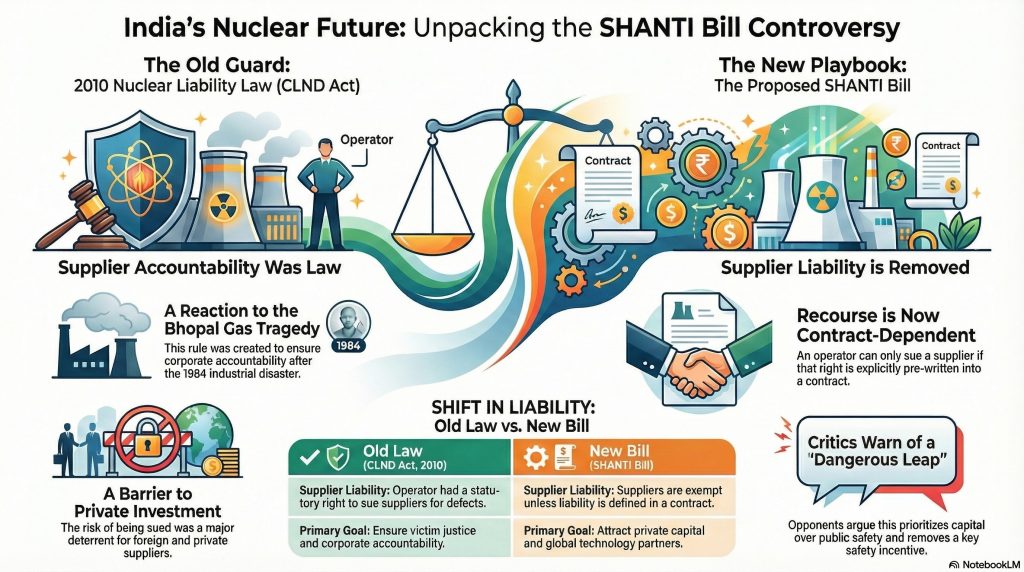
• Safety vs. Capital: Tharoor contended that the “pursuit of capital” must not be allowed to override non-negotiable requirements of public safety, environmental protection, and victim justice. He questioned the removal of the supplier liability clause, arguing that it compromises safety standards to favor corporate interests.
• “Unclear” Drafting and Misleading Definitions: Tharoor stated, “I am not sure whether it is a nuclear bill or an unclear bill,” highlighting a lack of legislative precision. He specifically criticized the bill’s preamble for describing nuclear energy as “clean,” arguing this is dangerously misleading because it ignores the irreversible risks of radioactive leaks and long-lived nuclear waste.
• The Irony of ‘SHANTI’: Referencing the bill’s acronym (meaning peace), Tharoor warned that the name could become a “cruel irony” in the aftermath of a preventable disaster. He, along with other opposition MPs, invoked the memory of the 1984 Bhopal Gas Tragedy to highlight the dangers of weakening liability frameworks for hazardous industries.
Why it matters
This debate highlights a significant shift in India’s nuclear governance, moving from a strict state monopoly to a privatized model involving major conglomerates like Adani and Reliance. Tharoor’s critique underscores public concern that the bill dismantles the “polluter pays” principle by capping operator liability and exempting suppliers from legal recourse in case of accidents. This change implies that while private companies may profit from power generation, the ultimate financial and health risks of a nuclear disaster may fall disproportionately on the state and the public rather than the equipment suppliers.
What happens next
Following its passage in the Lok Sabha via voice vote, the SHANTI Bill will now move to the Rajya Sabha for consideration. If enacted, it will end the monopoly of the Nuclear Power Corporation of India Ltd (NPCIL), allowing private firms to apply for licenses to build and operate reactors. The government aims to use this framework to increase nuclear capacity to 100 GW by 2047, with companies like Tata, Adani, and Reliance already conducting feasibility studies for Small Modular Reactors.