The Winter Session of the Indian Parliament, scheduled to conclude on 19 December 2025, has been marked by intense confrontation between the government and the Opposition over significant structural changes to India’s rural welfare and energy sectors. While the government is pushing ahead with an agenda to “Reform, Perform and Transform,” the Opposition has accused the Centre of “ideological vandalism” and bypassing parliamentary scrutiny by introducing legislation that fundamentally alters the existing legal and federal frameworks,.
What Happened?
The government introduced two major controversial pieces of legislation: the Viksit Bharat – Guarantee for Rozgar and Ajeevika Mission (Gramin) (VB-G RAM G) Bill and the Sustainable Harnessing and Advancement of Nuclear Energy for Transforming India (SHANTI) Bill. These are designed to replace the Mahatma Gandhi National Rural Employment Guarantee Act (MGNREGA) and the Atomic Energy Act of 1962, respectively,. Amidst the uproar, the Lok Sabha passed the Sabka Bima Sabki Raksha Bill, enabling 100 per cent Foreign Direct Investment (FDI) in the insurance sector, and the Repealing and Amending Bill, 2025, which removed 71 obsolete laws,. The session also witnessed protests by Opposition MPs regarding the alleged misuse of the Enforcement Directorate (ED) and demands for discussions on electoral roll irregularities,.
Key points
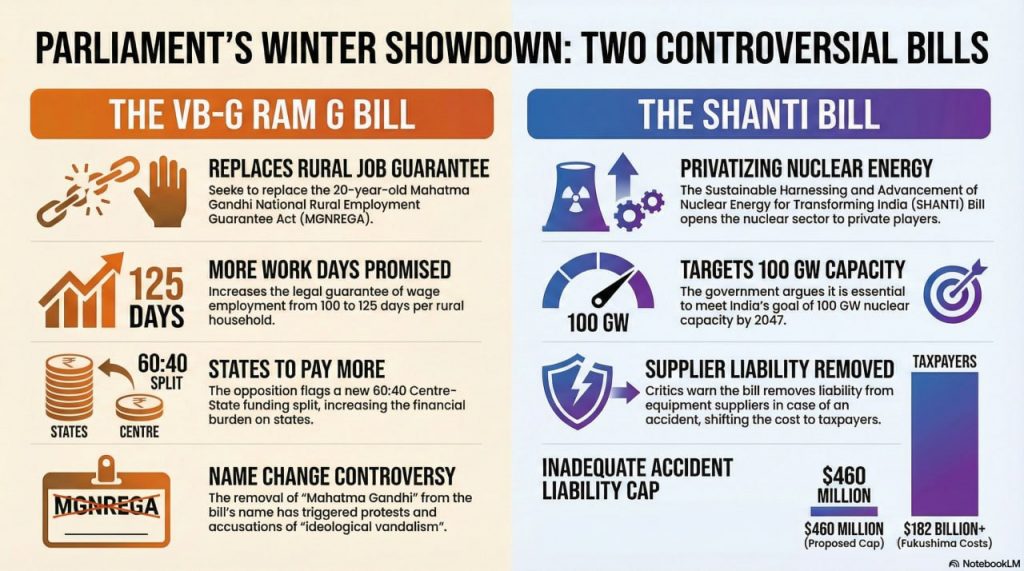
• Rural Employment Overhaul: The VB-G RAM G Bill increases the statutory guarantee of wage employment from 100 to 125 days per year. However, it proposes a 60:40 funding split between the Centre and States, a shift from the previous model where the Centre bore 100 per cent of wage costs, raising concerns about the financial burden on states. Opposition leaders also condemned the removal of Mahatma Gandhi’s name from the act and criticized the bill’s title as an imposition of Hindi,.
• Nuclear Privatisation: The SHANTI Bill opens the nuclear sector to private players to help meet a target of 100 GW capacity by 2047. Critics, including MP Shashi Tharoor, warned that the Bill caps liability at approximately ₹3,900 crore—deemed inadequate for potential disasters—and removes supplier liability, effectively asking taxpayers to subsidise the risks taken by private corporations,.
• Economic Liberalisation: The passing of the insurance amendment bill allows for 100 per cent FDI, which the Finance Minister argued would improve claim settlements and insurance penetration, though Opposition members warned it could disastrously impact domestic companies,.
• Procedural Grievances: The Opposition has strongly objected to these bills being pushed through without being referred to standing committees for detailed scrutiny, describing the process as “bulldozing”.
Why it matters
These legislative moves represent a significant pivot in India’s governance architecture. The SHANTI Bill marks a departure from the state’s monopoly on strategic nuclear assets, raising critical questions about safety protocols and corporate accountability in high-risk sectors. The VB-G RAM G Bill challenges the federal balance by shifting fiscal responsibilities to states and altering the “demand-driven” nature of the rural safety net. Furthermore, the removal of supplier liability in the nuclear sector and the renaming of the employment guarantee scheme signal deep ideological shifts that prioritize private sector integration and a specific cultural nationalism over previous consensus-based models,.
What Happens Next
With the session scheduled to end on 19 December 2025, the government is set to push for the consideration and passing of both the VB-G RAM G and SHANTI Bills in the Lok Sabha,. The Congress party has issued a three-line whip requiring the presence of all its MPs, indicating a final parliamentary showdown. If passed, these laws will likely face continued political resistance regarding their implementation, particularly concerning the financial compliance required from state governments for the new rural employment scheme.